The starting point
The store began as a local online pharmacy selling mainly within India. The goal was to turn its wide multi-brand range into a platform that could also sell to customers abroad, with search, conversion and paid advertising working together rather than as separate tasks.
That meant building the full growth architecture: store structure and category navigation, an international shipping flow, conversion improvements, and SEO-led acquisition supported by selective Google Ads.
The challenge
Large health catalogues have three problems that compound each other. Thousands of products share similar names and manufacturer descriptions, so pages compete with each other and with every other seller. Health products face strict advertising and Merchant Center policies. And shoppers need to trust a store before they pay for something they will take or give to their family.
This store’s main advantage is range: more than 24 brands in one place. The task was to turn that range into search visibility and completed orders.
Finding 1: payment method was driving cancellations
Order data showed a cancellation rate of almost one in four orders. Breaking it down by payment method changed the picture completely:
| Payment method | Cancellation rate |
|---|---|
| Cash on delivery | 57.1% |
| Prepaid (online payment) | 2.1% |
The problem wasn’t the products or the website; it was cash on delivery. That shifted the work away from general conversion tweaks and towards making prepaid the obvious choice, through pricing, clearer delivery costs and order confirmation calls.
Follow-up calls with first-time customers also showed why the remaining buyers dropped out: mostly delivery time, then shipping cost. Both now feature in the store’s delivery messaging and policies.
Finding 2: a core update exposed thin product content
Organic traffic fell sharply around a Google core update in March 2026. With thousands of products using near-identical manufacturer copy, thin and duplicate content was the most likely cause.
Rewriting 7,600 products at once isn’t realistic, so we prioritised. Using Search Console data, we identified the top 200 products by impressions and started rewriting those first, with unique descriptions written for shoppers and for search, not for ad policy alone.
Finding 3: policies are part of growth
Because the store buys stock daily against orders from several suppliers, some products take longer to arrive. Unclear policies were causing complaints and losses on cancelled prepaid orders. We rewrote the shipping, returns, cancellation and claims policies as one connected set, so shoppers know what to expect before they order and the business is protected when something goes wrong.
What we are doing now
- Rewriting product content in priority order, starting with the products closest to page one
- Running city-targeted Google Ads campaigns to spend budget where demand is strongest
- Tracking organic recovery and prepaid share of orders each month
Results
| Measure | Result |
|---|---|
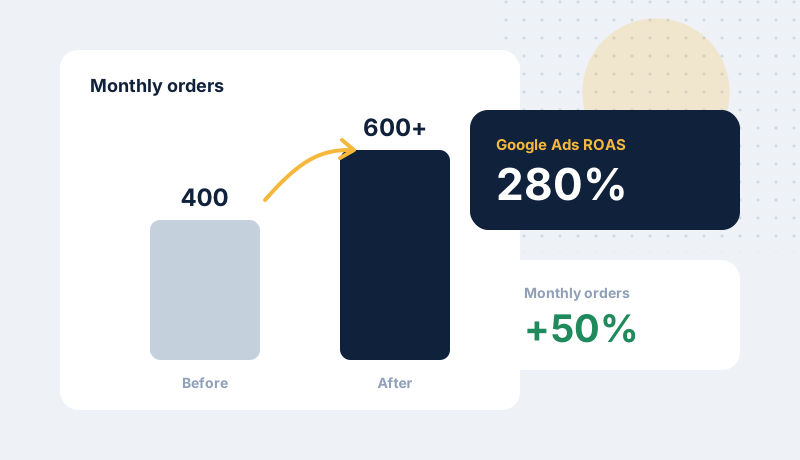
| Monthly orders | From about 400 to 600+ (+50%) |
| Google Ads return on ad spend | 280% on high-intent health searches, with a modest monthly budget |
| Organic traffic | +20% from content planning and category-level SEO, before the March 2026 core update |
| New markets | Regular orders from customers in Europe and the Gulf |
The work is ongoing. The core update set organic traffic back, and the product content rebuild is the response. We will update this page with the recovery figures once they are measured.
What this means for your store
If you run a large catalogue, the same approach applies: look at your order data by segment before changing the site, prioritise product pages by the search data you already have, and treat policies and delivery messaging as part of conversion.