16 November 2026, by Niraj Nagar
Why your products don’t appear when shoppers ask AI assistants
Shoppers are asking ChatGPT and Google’s AI for product recommendations. Many well-run stores are invisible in those answers, and don’t know why.
A growing number of shoppers no longer start with a search box and ten blue links. They ask an AI assistant: “What’s the best vegan protein powder under £30?” or “Which running shoes are good for flat feet?” The assistant replies with a handful of specific products, sometimes with prices and a link to buy.
If your products aren’t in those answers, you’re not just ranking lower. You’re absent from the conversation entirely. And most store owners have no idea whether they appear or not.
AI assistants don’t browse like people do
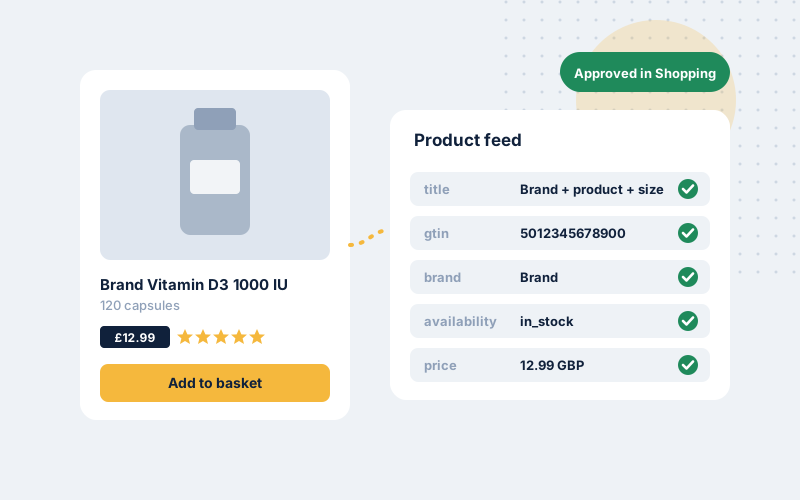
When a person visits your store, they can look at pictures, scroll through descriptions and piece together what a product is. AI systems work differently. They rely heavily on structured, consistent information: what the product is, who makes it, what it costs, whether it’s in stock, what customers think of it.
When that information is missing, contradictory or buried in marketing language, the assistant can’t be confident about your product. And when it isn’t confident, it recommends something else.
Your product data says different things in different places
On many stores, the website, the product feed and the structured data hidden in the page’s code each tell a slightly different story. The price on the page includes a discount the feed doesn’t know about. The brand is written three different ways. Stock status updates on the site but not elsewhere.
To a human, these are small details. To a system deciding which products to trust and recommend, they are warning signs.
Manufacturer descriptions make you indistinguishable
If you sell products from other brands, the easiest option is to use the manufacturer’s description. So do your competitors. And so do the marketplaces.
When dozens of sites carry identical text, there is nothing to suggest your store is the best place to buy. You’re competing on price alone, against sellers with far bigger budgets and far more authority.
Shoppers’ real questions go unanswered
AI assistants are built to answer questions. When a product page doesn’t clearly answer what shoppers actually ask (sizing, suitability, ingredients, compatibility, delivery times) there’s nothing for the assistant to draw on. Pages that answer those questions clearly are far more useful to cite.
Nobody is measuring it
Perhaps the biggest issue is that almost no store tracks this. Owners watch their Google rankings and their ad results, but have no visibility into whether AI assistants mention their brand, recommend their products or point shoppers to a competitor instead.
What isn’t measured doesn’t get fixed, and the gap widens as more shoppers change the way they search.
The opportunity hiding in the problem
The good news is that this is still early. Many competitors haven’t noticed the shift yet. Stores that get their product information into shape now have a real chance to be the ones assistants recommend, before the space gets crowded.
Preparing product catalogues for AI shopping is a core part of our product optimisation work for WooCommerce brands. If you’d like to know how your store looks from an AI assistant’s point of view, start with our free growth audit.